Butterfly Fan Zhendong ALC vs Nittaku Acoustic Carbon: Which Should You Buy?
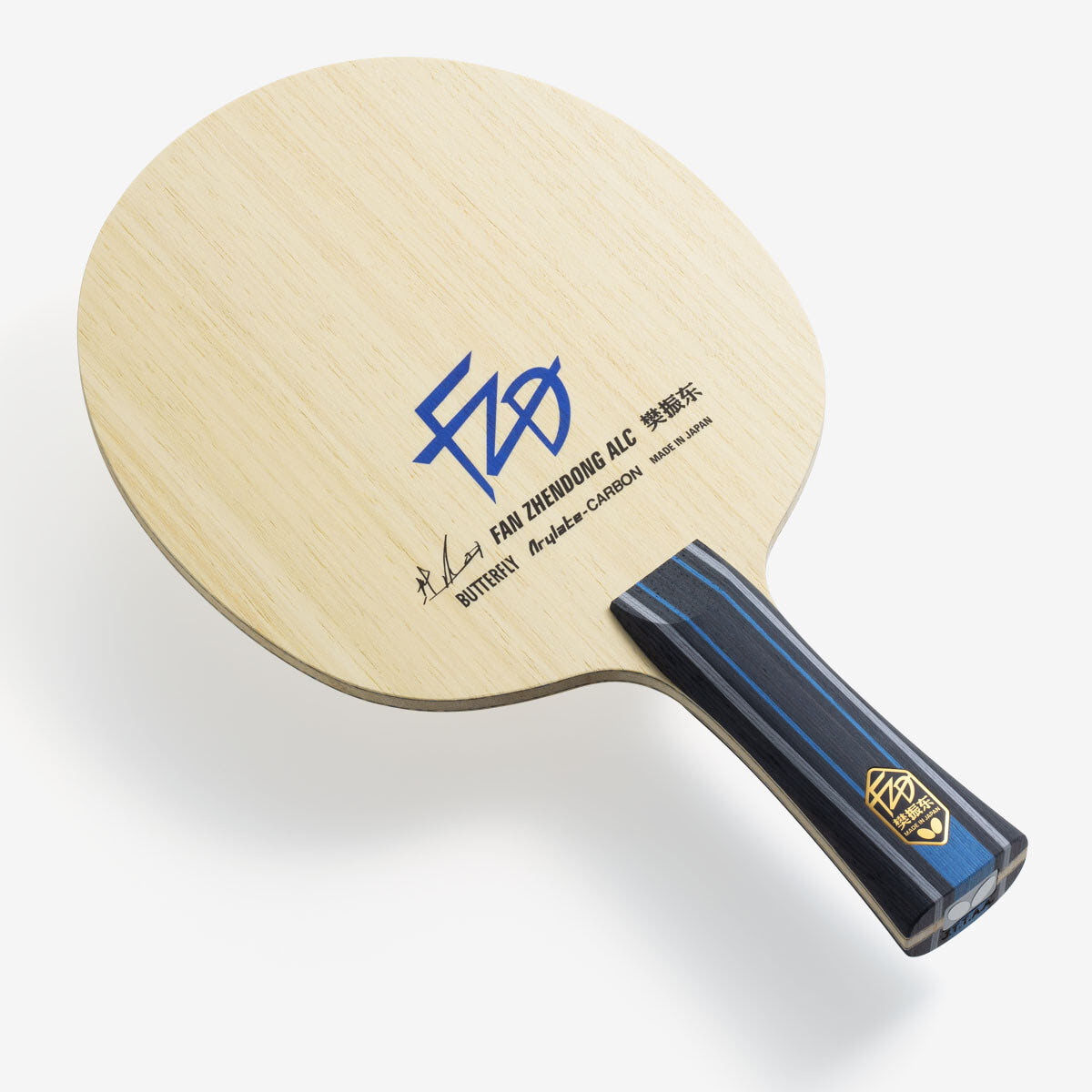
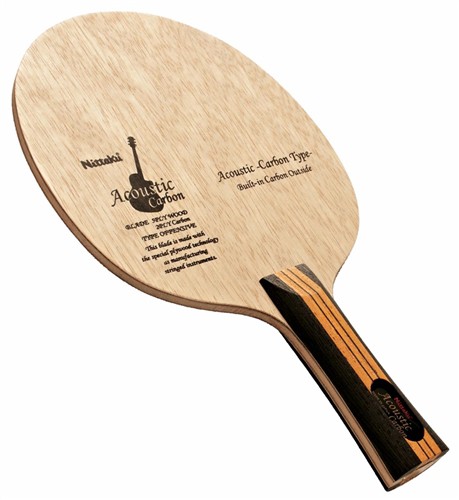
| Butterfly Fan Zhendong ALC | Nittaku Acoustic Carbon | |
|---|---|---|
| Our rating | 8.8/10 | 8.8/10 |
| feel | Crisp and direct with noticeable dwell on contact; slightly softer arc than Viscaria Super ALC | Medium-hard outer carbon with surprising wood-like dwell and ball retention; crisp sound on contact |
| handle | Flared (FL), Straight (ST), Anatomic (AN) — notably thicker grip than Viscaria | FL, ST (also Large Handle and Chinese Penhold variants available) |
| plies | 5 wood plus 2 arylate-carbon (ALC) — Koto / ALC / Limba / Kiri / Limba / ALC / Koto | 7 plies — 5 wood + 2 FE carbon (Limba - FE Carbon - Limba - Tung - Limba - FE Carbon - Limba) |
| speed | OFF | OFF |
| thickness_mm | approx 5.7mm | 5.5mm |
| weight_g | 87-92g typical | approx 90g |
We may earn a commission from links on this page. Learn more.
A genuine tie on paper, decided by feel
Both blades post an 8.8 overall rating - the only pair in this batch where the ratings are dead even. That makes the axis-level differences the entire story, and one of them is large enough to matter a lot: stiffness.
The stiffness gap is the headline
Acoustic Carbon scores 6.4 on stiffness against FZD ALC’s 5.2 - a 1.2-point gap, the largest single-axis difference between these two blades. That is not a marginal number. Acoustic Carbon’s own cons confirm the practical effect: “steep learning curve; the bounce can feel unruly until technique adapts” and “medium throw angle and head-heavy balance require adjustment from all-wood players.” FZD ALC, by contrast, is built specifically to be “forgiving at 100 percent power” with the ball staying on the table under heavy topspin - a direct contrast to Acoustic Carbon’s less forgiving profile away from the table, where “the stiffer feel limits dwell.”
Speed favors Acoustic Carbon by 0.4 (8.8 vs 9.2), and TableTennisReference and Revspin both note its 9.2 speed score specifically “matches TBALC and beats Viscaria and Tenor,” a meaningful claim if raw pace is your priority. Control is dead even at 9.0 for both - genuinely no difference here, so do not let marketing language about either blade’s control sway your decision without a stiffness-driven reason.
Hardness is a small 0.3-point gap (6.1 vs 6.4) - noticeable but secondary to the stiffness gap. Consistency actually favors FZD ALC by 0.4 (9.0 vs 8.6), which is worth flagging since it runs opposite to the speed and stiffness advantages Acoustic Carbon otherwise holds - you are trading some unit-to-unit predictability for Acoustic Carbon’s extra pace and pop.
Different carbon technology entirely
These are not variations on the same construction. FZD ALC uses 5 wood plies plus 2 arylate-carbon layers in a Koto-ALC-Limba-Kiri-Limba-ALC-Koto layup. Acoustic Carbon uses a 7-ply construction with 2 FE Carbon layers (Limba-FE Carbon-Limba-Tung-Limba-FE Carbon-Limba) - a different carbon material family entirely, one Revspin and TableTennisDaily reviewers describe as retaining “wood-like dwell and feel despite the outer FE Carbon layers,” which is Nittaku’s specific selling point against harder-feeling outer-carbon blades generally.
Value and rubber pairing
Acoustic Carbon carries two practical advantages the axis data does not show directly: it is priced below comparable Butterfly carbon blades, and it “soaks up sticky and tacky rubbers like NEO Hurricane 3 without trampolining” - meaning it specifically resists the ballooning effect some carbon blades get with tacky rubber. It is also reportedly used by professional player Ayane Morita, for whatever that endorsement is worth to you.
Should you switch?
If you are an all-wood player currently considering a first move into carbon, FZD ALC is the safer on-ramp: its forgiveness at full power and higher consistency score mean fewer surprises while your technique catches up to the blade. Acoustic Carbon is the better choice if you already loop with committed technique and specifically want more raw pace and a head-heavy, powerful feel, and you are willing to spend time adjusting to its stiffer, less forgiving profile away from the table.
If you already own FZD ALC and are tempted by Acoustic Carbon’s slightly higher speed score, weigh that 0.4-point gain against the 1.2-point stiffness jump and the 0.4-point consistency loss - you would be trading predictability for pace. If you already own Acoustic Carbon and loop aggressively with tacky rubber, there is little reason to move to FZD ALC unless you specifically want more forgiveness on full-power shots or you regularly play further from the table, where Acoustic Carbon’s dwell falls off.
Who each one actually suits
FZD ALC suits shakehand loopers with larger hands who want proven, forgiving power across a wide range of rubbers. Acoustic Carbon suits offensive players who loop close to mid-table, want carbon speed but do not want to give up wood-like touch and short-game precision, and who pair it with sticky or tacky forehand rubber.
Frequently asked questions
If both blades rate 8.8, which one should a beginner to carbon pick?
FZD ALC is the safer first carbon blade. It is more forgiving at full power and scores 0.4 points higher on consistency, while Acoustic Carbon's 1.2-point stiffness advantage brings a steeper learning curve that its own reviews describe as feeling unruly until technique adapts.
Is Nittaku Acoustic Carbon actually faster than Fan Zhendong ALC?
Yes, by 0.4 points on the aggregated speed axis (9.2 vs 8.8), and TableTennisReference notes its speed matches TBALC and beats Viscaria and Tenor. But that speed comes with a stiffer, less forgiving feel away from the table.
Do these blades use the same kind of carbon?
No. FZD ALC uses arylate-carbon (ALC) in a 5-wood-plus-2-carbon layup. Acoustic Carbon uses FE Carbon in a 7-ply construction. Reviewers describe Acoustic Carbon's FE Carbon as unusually wood-like in feel despite being a different carbon family.
Which blade pairs better with tacky rubber?
Acoustic Carbon has a specific stated advantage here: it soaks up sticky and tacky rubbers like NEO Hurricane 3 without trampolining, which is a notable claim since carbon blades often exaggerate tacky rubber's bounce.