Butterfly Fan Zhendong ALC vs Butterfly Zhang Jike ALC: Which Should You Buy?
| Butterfly Fan Zhendong ALC | Butterfly Zhang Jike ALC | |
|---|---|---|
| Our rating | 8.8/10 | 8.7/10 |
| feel | Crisp and direct with noticeable dwell on contact; slightly softer arc than Viscaria Super ALC | medium-hard but flexible, crisp carbon with long dwell |
| handle | Flared (FL), Straight (ST), Anatomic (AN) — notably thicker grip than Viscaria | FL/ST/AN |
| plies | 5 wood plus 2 arylate-carbon (ALC) — Koto / ALC / Limba / Kiri / Limba / ALC / Koto | 5W+2 Arylate-Carbon (5 wood plies with 2 Arylate-Carbon layers) |
| speed | OFF | OFF |
| thickness_mm | approx 5.7mm | 5.8 |
| weight_g | 87-92g typical | 88 |
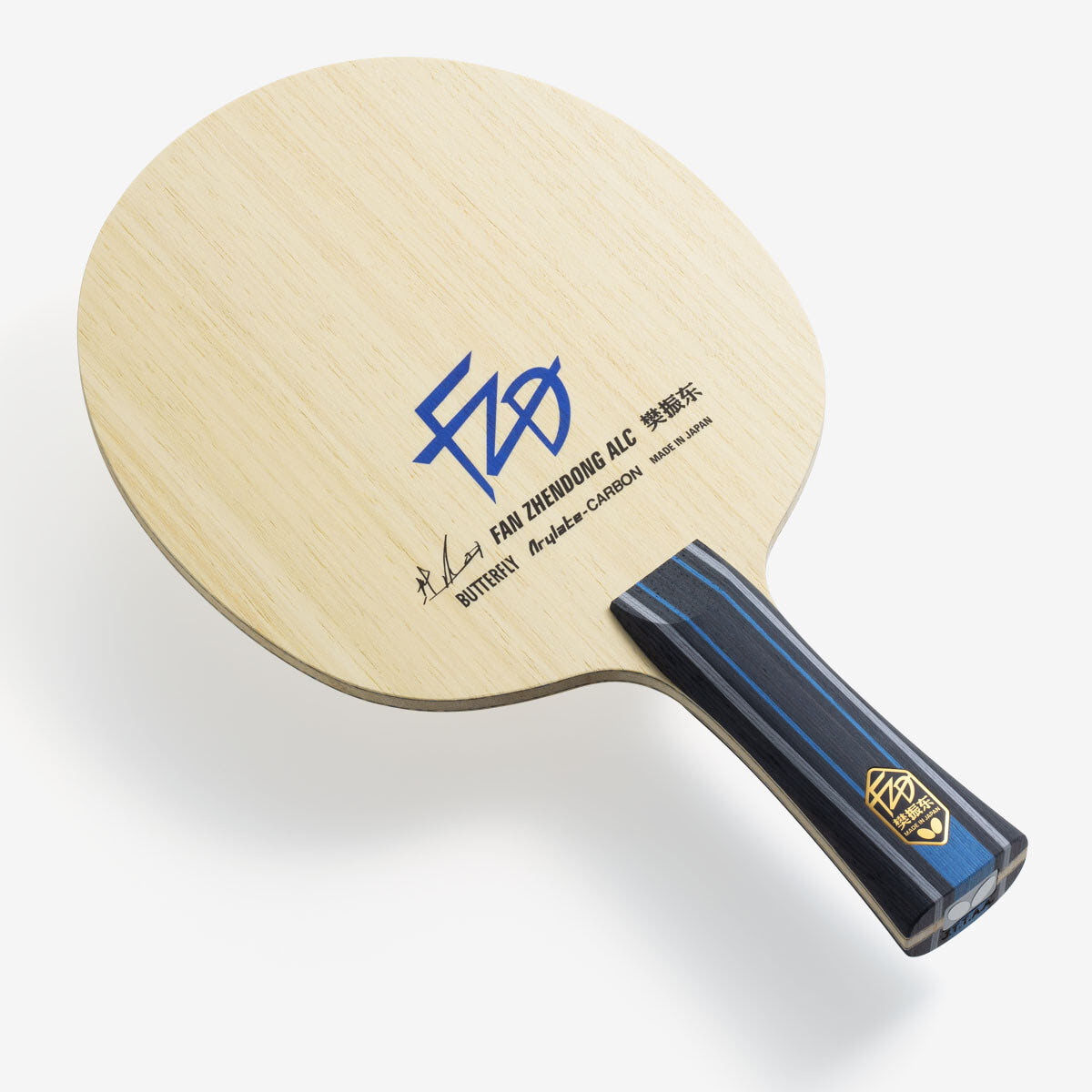
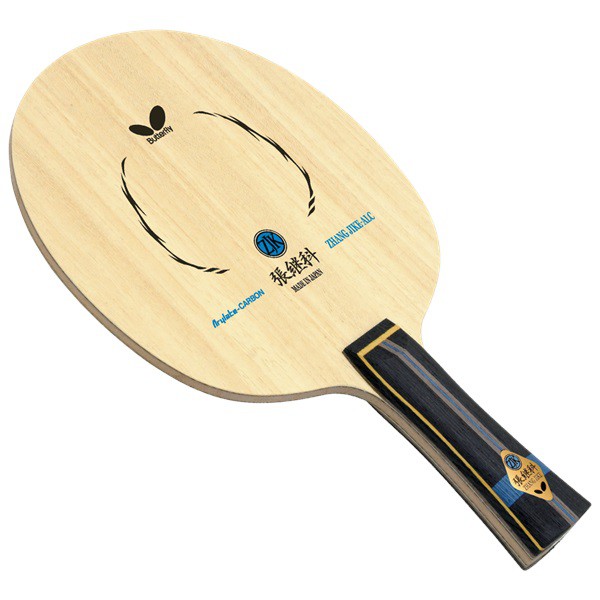
We may earn a commission from links on this page. Learn more.
The short answer
These two Butterfly outer-ALC blades are about as close as a comparison gets to a genuine coin flip. Fan Zhendong ALC (FZD ALC) rates 8.8 overall, Zhang Jike ALC (ZJ ALC) rates 8.7. Both share a 5-wood-plus-2-arylate-carbon construction descended from the same Viscaria-class carbon layup, both are OFF-class, and both work across a wide range of rubber choices. If you are choosing between these two specifically, rather than deciding whether to go carbon at all, the differences are real but narrow, and the decision should hinge on two things the headline rating does not show: consistency and availability.
Where the numbers actually diverge
Revspin’s aggregated axis scores put ZJ ALC ahead on every offensive axis, but the size of each gap matters more than its direction. Speed is a 0.2-point gap (8.8 vs 9.0) - below the threshold most players can feel shot to shot. Stiffness is a 0.1-point gap (5.2 vs 5.3) - essentially identical, and neither blade should be described as noticeably stiffer than the other despite ZJ ALC’s marketing language about a ‘soft, flexible, non-stiff carbon feel.’ That description is relative to stiffer ALC and ZLC blades in the wider market, not relative to FZD ALC specifically.
Two gaps are large enough to matter. Hardness runs the other direction: FZD ALC scores 6.1 versus ZJ ALC’s 5.2, a 0.9-point gap that is the biggest swing in either blade’s favor. That means FZD ALC will feel noticeably crisper and more direct off the blade, while ZJ ALC has more give and a longer, softer catch on contact. And consistency is the standout difference: ZJ ALC posts 9.7 against FZD ALC’s 9.0, a 0.7-point gap. Revspin’s consistency axis reflects how uniform the blade performs unit to unit and stroke to stroke, and a gap this size is the kind of thing that shows up as fewer mishits over a season of use, not just a first-impression difference.
Control shows a small 0.3-point edge to ZJ ALC (9.3 vs 9.0), consistent with TableTennisDaily reviewers calling it strong control relative to other ALC and ZLC blades.
What the reviews say beyond the numbers
Revspin, TableTennisDaily and Megaspin all independently praise FZD ALC’s dwell time and its forgiveness at full power - reviewers specifically note the ball stays on the table even under heavy topspin at 100 percent effort, a meaningful claim for players who commit fully to their loop. Revspin, TableTennisDaily and Reddit’s r/tabletennis threads on ZJ ALC converge on a different strength: its away-from-table looping and counterlooping, plus genuine handle choice across FL, ST and AN shapes, versus FZD ALC’s single, notably thicker grip.
One practical factor the axis data cannot capture: ZJ ALC has, per its own listed cons, been heading toward discontinuation, which affects new-stock availability. That is not a performance knock, but it is a real purchasing consideration - if you cannot reliably source ZJ ALC, the rest of this comparison becomes academic.
Should you switch?
If you already own FZD ALC and are wondering whether ZJ ALC is a meaningful upgrade: probably not enough to justify replacing a blade you are already comfortable with. The 0.1-point rating gap and the small deltas on speed and stiffness mean you are not leaving significant offensive capability on the table. The one legitimate reason to switch is if you specifically want more unit-to-unit predictability (the 0.7-point consistency gap) or you have small-to-medium hands and want handle-shape options FZD ALC does not offer in its single thicker grip.
If you already own ZJ ALC and like it, do not chase FZD ALC for better numbers - there are none worth chasing here. Buy FZD ALC instead only if you have larger hands and previously bounced off a thin-handled ALC blade like Viscaria, since that is FZD ALC’s specifically stated advantage, or if availability of ZJ ALC becomes a genuine problem.
Who each one actually suits
FZD ALC is the safer pick for aggressive shakehand loopers with larger hands who want proven, forgiving power - it is explicitly not recommended for penholders or passive blockers. ZJ ALC suits offensive loopers who want handle-shape flexibility and slightly more control and consistency, and who are comfortable pairing either tensor or tacky Chinese rubber on the forehand, provided they can find stock while it remains available.
Frequently asked questions
Is Zhang Jike ALC actually better than Fan Zhendong ALC?
Marginally, on paper. It leads on speed, control and consistency by small to moderate amounts, and its 9.7 consistency score versus FZD ALC's 9.0 is the biggest gap of the two. But FZD ALC is harder and crisper (6.1 vs 5.2 on hardness) and comes in a thicker single handle rather than a handle choice. The 0.1-point overall rating gap does not point to a clear winner.
Should I worry about Zhang Jike ALC being discontinued?
If you cannot find current stock reliably, yes - treat this as a practical dealbreaker rather than a performance question. FZD ALC remains in active production and is the safer long-term buy if you want to be able to replace or match a blade later.
Which handle should I pick if I have larger hands?
FZD ALC's handle is notably thicker than the Viscaria it is descended from, which is its specific fix for players who found Viscaria too thin. ZJ ALC offers FL, ST and AN shapes, so larger-handed players have more shape options to try even though none is specifically marketed as thicker.
Do these two blades feel the same in stiffness?
Yes, essentially. The stiffness delta is only 0.1 points (5.2 vs 5.3), so any stiffness difference you read about elsewhere is likely being compared against other blades in the wider ALC and ZLC market, not between these two specifically.