Andro Rasanter R50 vs Butterfly Tenergy 80: Which Should You Buy?
| Andro Rasanter R50 | Butterfly Tenergy 80 | |
|---|---|---|
| Our rating | 8.8/10 | 8.8/10 |
| Best side | Forehand | Both wings |
| Control (different scales) | 7.5 | medium-high |
| Speed (different scales) | 9.4 | 13.5/14 |
| Spin (different scales) | 9.4 | 11.2/12 |
| Sponge hardness | 50° | 36° |
| Type | tensor/non-tacky | tensor inverted (Spring Sponge) |
| Uncut weight | 70 g | 67 g |
A row marked “different scales” puts two rating systems in one line. Those cells are not a single score you can subtract.
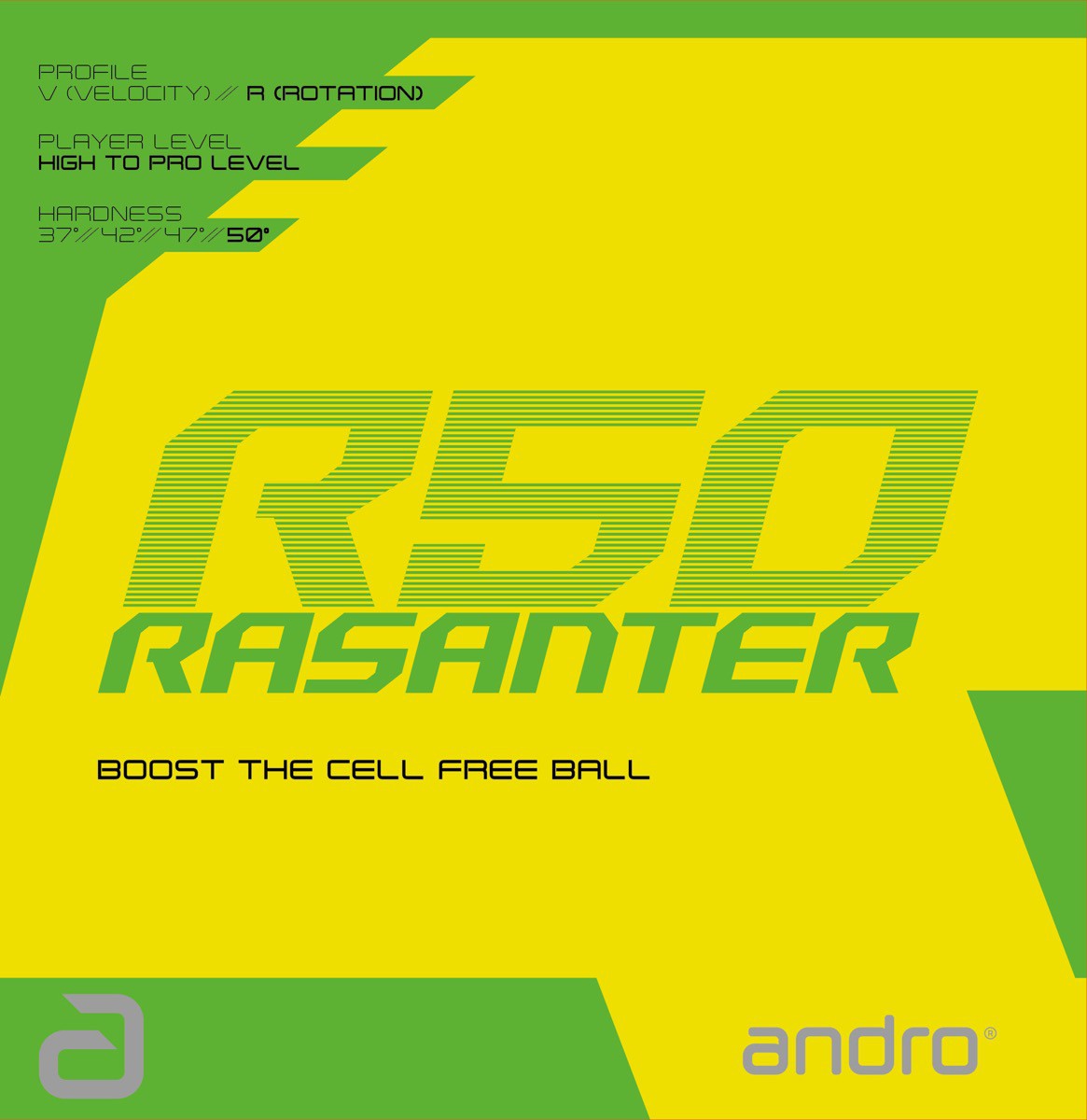

We may earn a commission from links on this page. Learn more.
The rare case where the two rubbers are genuinely tied
Andro Rasanter R50 and Butterfly Tenergy 80 both carry the same 8.8 community rating, tie exactly on throw (5.9 vs 5.9, delta 0) and land within a tenth of a point on speed (9.4 vs 9.3) and spin (9.4 vs 9.4, delta 0). Of the pairs of rubbers compared against this Rasanter R50 in this dataset, this is the closest match by far. If you are choosing between these two on raw radar numbers alone, you are choosing between two rubbers that play almost identically at the table.
The two axes where a real gap exists
Control: 8.7 vs 9.0 (delta -0.3). Tenergy 80 is the more forgiving rubber for placement, and its own bestFor line leans into that, describing it as forgiving with elite blocking.
Durability: 8.3 vs 7.7 (delta 0.6). R50 pulls ahead here, and by a meaningful margin — more than half a point on a 10-point scale. If cost-per-month is part of your buying decision, this is the number that tips it toward R50, especially since Tenergy 80 already carries the Dignics/Tenergy premium price tag.
Tackiness: 1.8 vs 2.1 (delta -0.3) is a small edge to Tenergy 80 for short-game grip; not decisive on its own.
Both rubbers make the exact same marketing claim — do they both deliver?
Here’s something unusual in the source data: R50’s pros list says it has less sensitivity to incoming opponent spin than softer alternatives, and Tenergy 80’s pros list independently says it has lower spin sensitivity than many tensors, so reading incoming spin is easier. Two different manufacturers, two different rubbers, making the identical pitch. Given how close their tackiness numbers are (1.8 vs 2.1, only a 0.3 gap) that claim looks credible for both — neither rubber is a spin-sponge that magnifies whatever the opponent throws at it, which is worth knowing if serve-receive consistency is a priority for you.
Where the real decision lives: the blade, not the rubber
With the radar numbers this close, the more useful signal in the source data is fit. Tenergy 80’s bestFor explicitly recommends it mounted on a 5-ply OFF wood blade, where its own cons note the springy sponge can pop pushes up close to the table until you adjust your angle — a rubber that wants a specific blade family to stay controllable. R50’s bestFor stays forehand-specific and power-loop focused with no particular blade caveat beyond needing full swing commitment. If you already own a 5-ply OFF wood blade and play mid-distance, Tenergy 80 is tuned for exactly that setup. If you play closer to the table or want one rubber that is agnostic to blade choice, R50 has fewer strings attached.
What Revspin and Racket Insight add
Racket Insight’s Tenergy 80 review frames it as the more direct, less bouncy sibling of Tenergy 05 — consistent with the tied throw number here, since Tenergy 80 was specifically built to flatten Tenergy 05’s famously high arc. Revspin’s rubber database is the primary source behind both rubbers’ aggregated numbers in this comparison, and Megaspin’s product reviews corroborate the durability and blocking notes from the pros and cons lists.
Who should buy each
R50: players who want a slightly more durable, blade-agnostic power rubber for the forehand and don’t want to think about which blade family it needs.
Tenergy 80: players who already have or plan to buy a 5-ply OFF wood blade and want elite blocking with a flatter, more direct topspin arc than Tenergy 05.
The weight and price angle
The spec rows put R50 at 70g uncut against roughly 67g for Tenergy 80 — a small enough gap that it shouldn’t force any rebalancing of your finished racket, unlike some other pairings in this dataset. Where the two setups really part ways is price: Tenergy 80 carries the full Dignics-era Tenergy premium, while R50 positions itself explicitly as the lower-cost route to comparable pace and spin. If the numbers above read as a near-tie to you, that price gap combined with R50’s durability edge is a reasonable tiebreaker in R50’s favor for anyone not locked into the 5-ply OFF wood blade pairing Tenergy 80 wants.
Frequently asked questions
Are Andro Rasanter R50 and Butterfly Tenergy 80 basically the same rubber?
On the radar numbers, they are very close -- tied throw (5.9 both), tied spin (9.4 both), and within a tenth of a point on speed. The real differences are a 0.3-point control edge for Tenergy 80 and a 0.6-point durability edge for R50.
Does Tenergy 80 need a specific blade?
Its own bestFor line recommends mounting it on a 5-ply OFF wood blade, where its cons note it stays controllable instead of getting too bouncy; R50 doesn't carry the same blade restriction in the source data.
Which rubber is more durable?
R50, by 0.6 points (8.3 vs 7.7) -- the largest gap between these two rubbers on any axis.
Do both rubbers really have low spin sensitivity?
Both make that claim in their own pros lists, and their tackiness scores are close enough (1.8 vs 2.1) to support it -- neither is a rubber that magnifies incoming spin the way Tenergy 05 does.