Andro Rasanter R50 vs Butterfly Tenergy 05: Which Should You Buy?
| Andro Rasanter R50 | Butterfly Tenergy 05 | |
|---|---|---|
| Our rating | 8.8/10 | 9.0/10 |
| Best side | Forehand | Both wings |
| Control (different scales) | 7.5 | medium-high |
| Speed (different scales) | 9.4 | 13.0/14 |
| Spin (different scales) | 9.4 | 11.5/12 |
| Sponge hardness (different scales) | 50° | 36° (Butterfly scale) |
| Type | tensor/non-tacky | tensor inverted |
| Uncut weight | 70 g | 68 g |
A row marked “different scales” puts two rating systems in one line. Those cells are not a single score you can subtract.

We may earn a commission from links on this page. Learn more.
The rubber that dares to compare itself to Tenergy 05
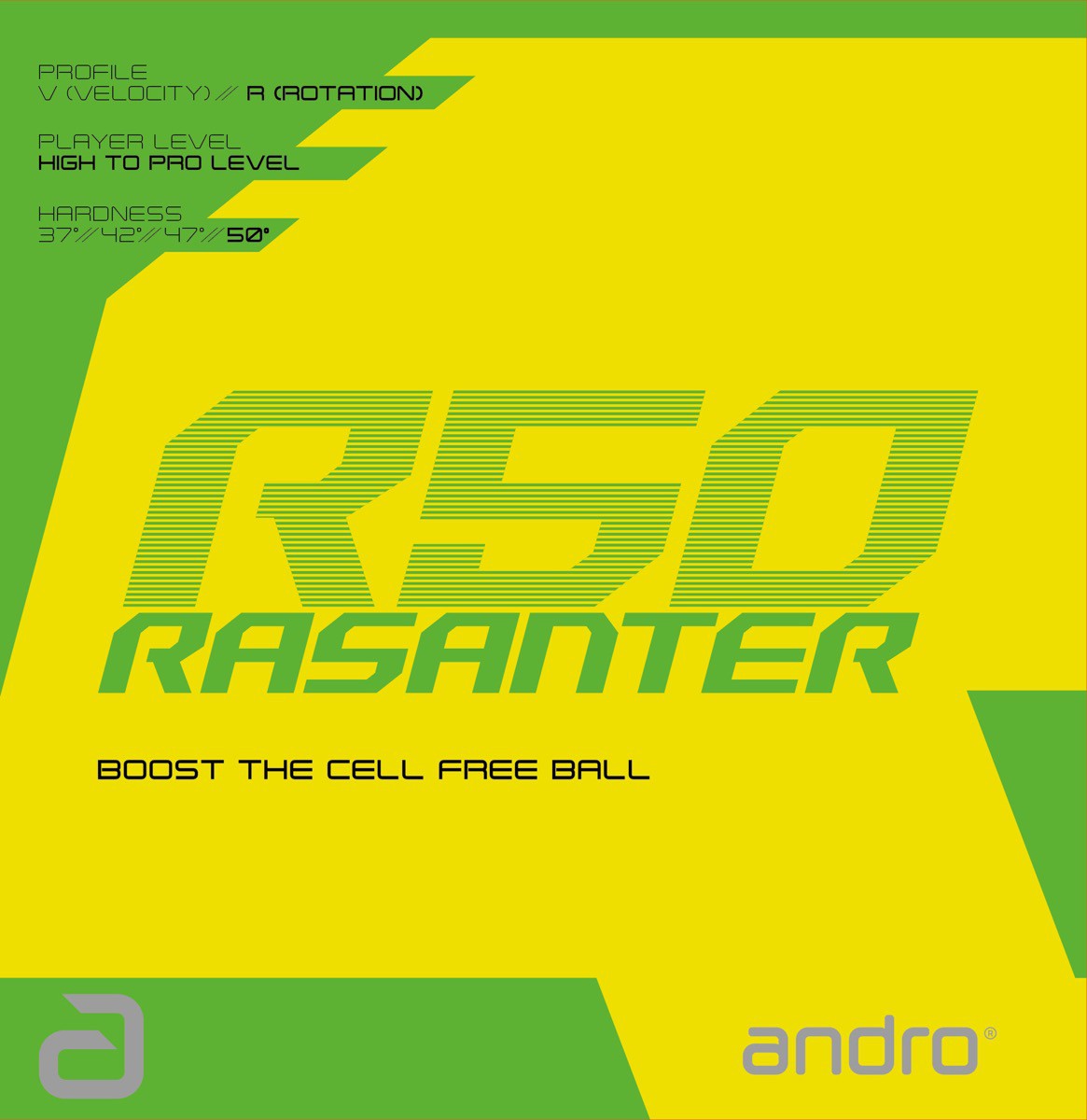
Andro Rasanter R50’s own pros list makes a bold claim: explosive speed that rivals Tenergy 05 at a lower price. Its bestFor line doubles down, describing R50 as delivering Tenergy 05-level performance at a lower cost. That is a specific, testable claim, and the axis data lets us actually test it rather than just repeat the marketing line.
Where the claim holds up
Speed: 9.4 vs 9.3 (delta 0.1). Essentially tied — the rivals-Tenergy-05 speed claim checks out on this axis.
Spin: 9.4 vs 9.4 (delta 0). Dead even. Two rubbers with completely different pedigrees producing an identical spin number is a genuinely useful data point for anyone who assumed Tenergy 05 was untouchable on spin.
Control: 8.7 vs 8.3 (delta 0.4). R50 is actually ahead here, not behind — a modest but real edge in the rubber usually described as the budget option.
Durability: 8.3 vs 7.7 (delta 0.6). This is the biggest gap in R50’s favor, and it matters in practice: Tenergy 05’s own cons note it is very spin-sensitive, and heavily-used tensor sheets in this performance tier tend to lose their catapult over months of play. A 0.6-point durability edge is the kind of number that shows up as extra weeks of usable life on the sheet.
Where the claim falls apart
Throw: 5.9 vs 7.6 (delta -1.7). This is the largest single gap anywhere in this comparison, and it undercuts the rivals-Tenergy-05 pitch more than any other number. Tenergy 05’s legendary throw angle — the trait Revspin and generations of forum threads built its reputation on — is simply not something R50 replicates. R50 plays lower and flatter; Tenergy 05 launches the ball up and out with a springy catapult that R50’s harder, less bouncy sponge does not match.
Tackiness: 1.8 vs 2.3 (delta -0.5). Tenergy 05 grips the ball slightly more on contact, which plugs into its reputation for effortless short-game spin and easy blocking — described in its own pros as making the block go near-automatic once you dial in the blade angle.
What the sources say
Revspin’s rubber database is the reference point most of the internet cites for Tenergy 05’s numbers, and the rubber’s own bestFor line calls it the global reference point that Tenergy 19 and Dignics 05/09C are all benchmarked against — Tenergy 05 is not just a rubber here, it is the yardstick. Reddit’s r/tabletennis threads consistently flag its spin-sensitivity on serve receive as the main technical hurdle, which lines up with the -0.5 tackiness delta above.
So does R50 actually rival Tenergy 05?
On speed and spin, yes — the numbers back the marketing claim almost exactly. On throw, no — a 1.7-point gap is not a rounding error, it is a different playing character. If your game depends on Tenergy 05’s high, bouncy arc to loop against backspin from off the table, R50 will feel flatter and less forgiving in that specific situation. But if what you actually valued about Tenergy 05 was raw speed and spin for a full-swing attacking game, R50 delivers close to identical output, with better control and meaningfully better durability, at a lower price.
Who should buy each
R50: attacking players who want Tenergy 05-class speed and spin without the premium price, and who do not depend heavily on a high throw angle for their loop technique.
Tenergy 05: players whose loop game is built around the highest throw and spin available and who are willing to manage its spin-sensitivity and premium price to get it.
One more thing to weigh: cut weight
The spec rows put R50 at roughly 70g uncut versus 68g for Tenergy 05 — close enough that this pairing, unlike some of the others in this dataset, will not force a rebalance of your finished racket. That means the decision here really does come down to the axis deltas above rather than a hidden weight surprise, which makes this one of the more straightforward swaps to evaluate on the numbers alone.
Frequently asked questions
Does Andro Rasanter R50 really rival Butterfly Tenergy 05, as its own marketing claims?
Partially. Speed and spin numbers are essentially tied (deltas of 0.1 and 0), matching the marketing claim. But throw is 1.7 points lower for R50, a large enough gap that the two rubbers play with noticeably different arc and catapult, so rivaling Tenergy 05 does not mean playing identically to it.
Is Tenergy 05 more spin-sensitive than R50?
Yes. Tenergy 05's tackiness rates 0.5 points higher, and its own cons list flags it as very spin-sensitive, making serve receive and reading incoming spin harder than on R50.
Which rubber lasts longer?
R50, by 0.6 points on the durability axis (8.3 vs 7.7) -- a real edge, though Tenergy 05 remains the more famous rubber for outright loop quality.
Should I switch from Tenergy 05 to R50 to save money?
If your game depends on Tenergy 05's very high throw angle to loop against backspin from off the table, switching will change your technique requirements -- R50 plays notably flatter. If you mainly value raw speed and spin for a full-swing attacking game, the data shows R50 delivering nearly identical output at lower cost with better control and durability.