Andro Rasanter R50 vs Butterfly Dignics 80: Which Should You Buy?
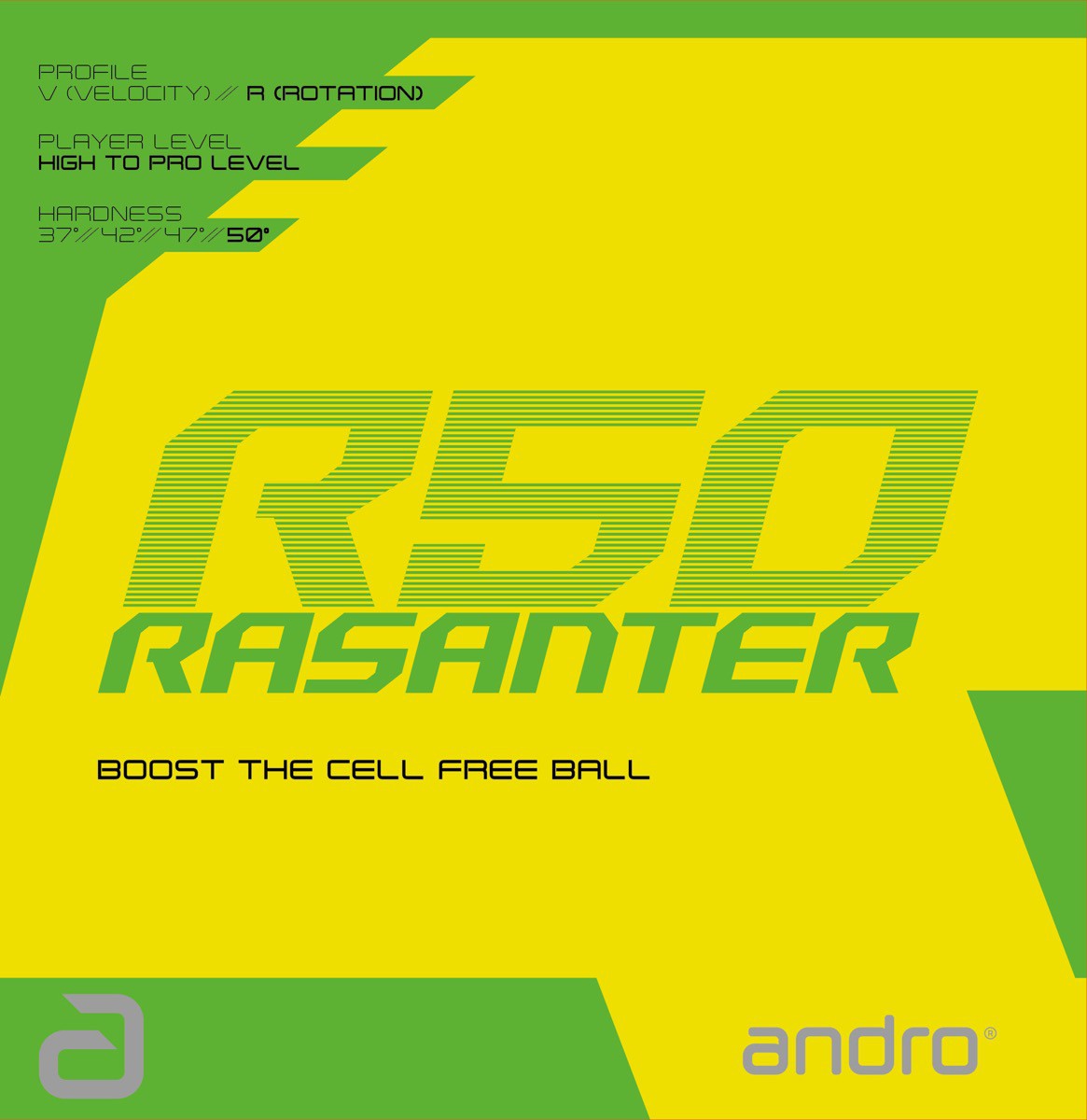
| Andro Rasanter R50 | Butterfly Dignics 80 | |
|---|---|---|
| Our rating | 8.8/10 | 9.0/10 |
| Best side | Forehand | FH and BH (both sides) |
| Control (different scales) | 7.5 | medium |
| Speed (different scales) | 9.4 | very high |
| Spin (different scales) | 9.4 | very high |
| Sponge hardness | 50° | approximately 40 degrees |
| Type | tensor/non-tacky | Inverted (tensor, Spring Sponge X) |
| Uncut weight | 70 g | approximately 70 g |
A row marked “different scales” puts two rating systems in one line. Those cells are not a single score you can subtract.

We may earn a commission from links on this page. Learn more.
Same speed, same weight, different verdict
Andro Rasanter R50 and Butterfly Dignics 80 tie dead-even on speed (9.4 vs 9.4, delta 0) and land within a gram of each other on weight (70g vs approximately 70g uncut). If you only looked at those two numbers you’d call this a wash. The community-aggregated rating tells a different story: R50 sits at 8.8, Dignics 80 at 9.0 — a modest but real edge, and the axis data explains where it comes from.
The two axes that actually separate them
Spin: 9.4 vs 9.1 (delta 0.3). R50 keeps a small spin advantage on full-swing forehand loops. Not huge, but real — 0.3 on this scale usually shows up as a slightly higher rotation rate on the exact same stroke.
Durability: 8.3 vs 8.7 (delta -0.4). This is the biggest gap on the sheet, and it favors Dignics 80. Its own pros list claims it lasts around twice as long as Tenergy, and a 0.4-point durability edge over an already-durable R50 backs that up — if cost-per-month of play matters to you, this is the number to weigh against the higher sticker price.
Control: 8.7 vs 8.9 (delta -0.2) and throw: 5.9 vs 5.5 (delta 0.4) are both small. Dignics 80 is marginally easier to place, R50 arcs the ball marginally higher. Neither is a reason to switch on its own.
Tackiness: 1.8 vs 1.7 (delta 0.1). Both are firmly non-tacky tensors; ignore this axis entirely for decision-making.
The spec row that matters more than any radar axis
Best side: R50 is forehand only. Dignics 80 is explicitly rated for FH and BH, both sides. That is the real differentiator in this matchup, and it is not captured anywhere in the six radar numbers. R50’s own cons list says short-game touch techniques like stops and pushes are difficult and that it demands full swing commitment — consistent with a forehand-specialist rubber. Dignics 80’s pros describe it as the most balanced rubber in the Dignics line, strong on both wings. If your plan is to run one rubber across the whole blade rather than mixing forehand and backhand sheets, that single spec line matters more than the 0.3-point spin edge or the 0.2-point control edge.
What the reviewers actually say
RacketInsight’s rubber-by-rubber Dignics comparison and TableTennisDaily’s review both single out Dignics 80 for reviving what one calls the Tenergy 05 catapult feel that the harder Dignics 05 lacks — in other words, Dignics 80 is Butterfly’s attempt to combine Dignics-line durability with Tenergy-style bounce. Reddit’s r/tabletennis threads on the rubber echo that it rewards fast arm speed and clean technique rather than passive play, which matches its own cons entry about needing clean technique and fast arm speed to unlock its potential.
Should you switch from R50?
Be honest about what you’re paying for. Dignics 80 costs more and gives you back a 0.4-point durability edge, a small control bump, and two-wing versatility — but it costs you 0.3 points of spin. If you already run R50 on the forehand only and are happy with it, there is no urgent reason to switch just for the numbers; the case for Dignics 80 is really about wanting a single rubber for both wings, not about R50 being worse. If you are building a new setup from scratch and want one sheet across the whole blade, Dignics 80’s dual-wing rating is the deciding factor, not the radar chart.
Who should buy each
R50: forehand-only power loopers who want maximum spin and are fine mixing in a separate backhand rubber.
Dignics 80: intermediate-to-advanced players with fast arm speed who want one durable, balanced rubber for both wings, paired naturally with inner-carbon blades like the Timo Boll ALC.
Frequently asked questions
Is Butterfly Dignics 80 worth the extra cost over Andro Rasanter R50?
Only if you specifically want one rubber that performs well on both forehand and backhand -- Dignics 80's own pros highlight it as the most balanced sheet in the Dignics line for both wings, while R50 is rated for the forehand only. On raw speed the two are tied, so the premium mainly buys durability and two-wing versatility, not more spin.
Which rubber has better durability?
Dignics 80, by 0.4 points on the radar data (8.7 vs 8.3), backed by its own pros claim of lasting about twice as long as Tenergy.
Do these rubbers feel similar in speed?
Yes -- they tie exactly on the speed axis at 9.4, so any perceived speed difference in play is more likely coming from blade choice or stroke than from the rubber itself.
Can I put Dignics 80 on just my backhand?
Yes, and given its rating for both wings that's a reasonable use, though you would not be using its full-blade versatility -- pairing R50 on the forehand with Dignics 80 on the backhand is a viable two-rubber setup based on the data here.