Andro Rasanter R47 vs Butterfly Tenergy 19: Which Should You Buy?
| Andro Rasanter R47 | Butterfly Tenergy 19 | |
|---|---|---|
| Our rating | 8.6/10 | 8.7/10 |
| best_side | both | forehand |
| control | medium | high — extended dwell time provides greater margin for error than other Tenergy variants |
| speed | high | 132 |
| spin | high | 117 |
| sponge_hardness | 47° | 36 degrees (approx 48 degrees ESN) |
| type | tensor inverted | inverted / pimples-in tensor |
| weight_uncut_g | 69 | approx 49 g |

We may earn a commission from links on this page. Learn more.
The headline: close numbers, very different price and weight
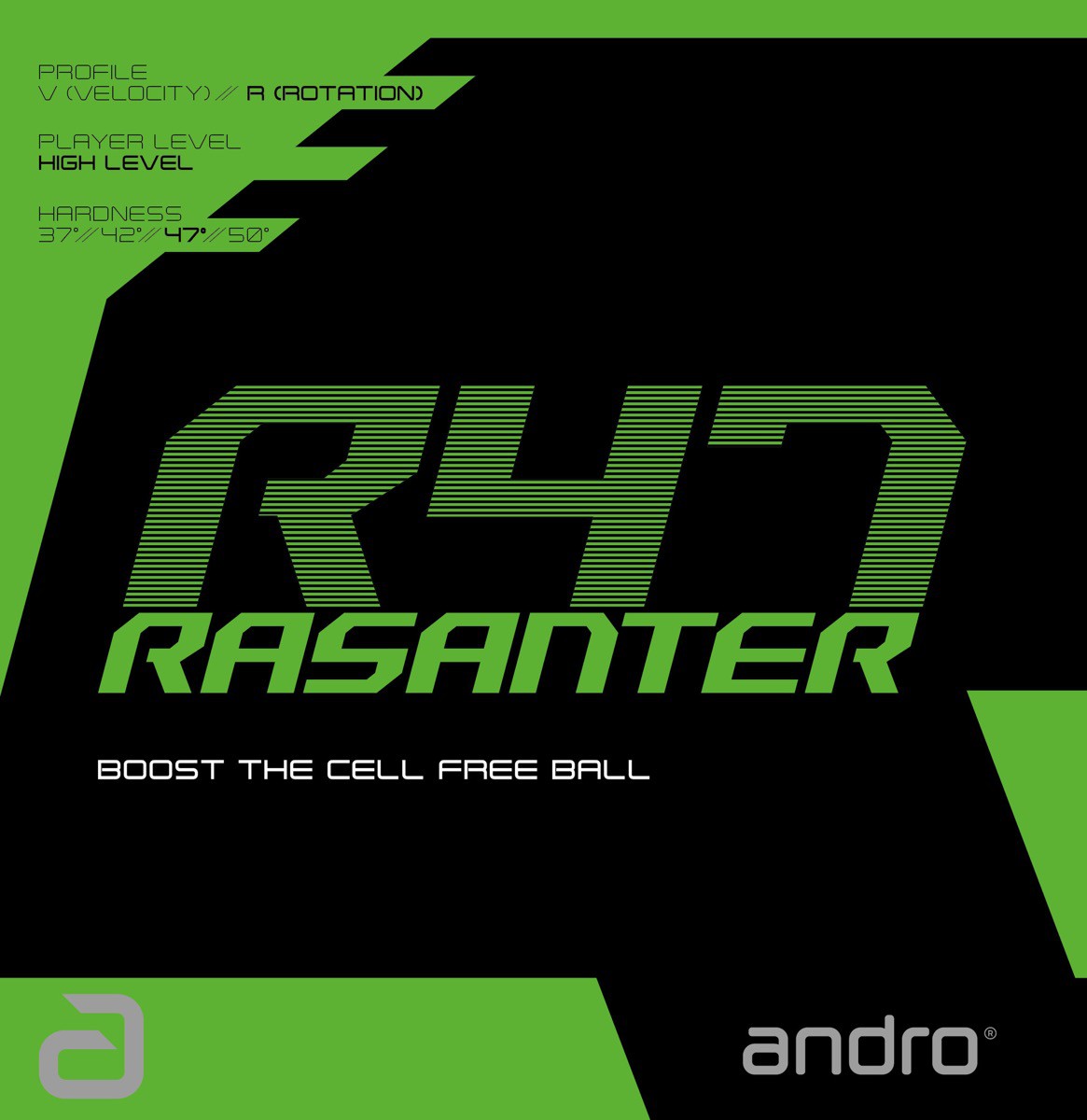
Andro Rasanter R47 (8.6 rating) and Butterfly Tenergy 19 (8.7 rating) are close enough on the radar chart that the deciding factors for most players will be price and weight rather than raw performance. R47’s own pros describe it explicitly as a lower-cost route to Tenergy-05-style performance; Tenergy 19’s own cons flag it as one of the most expensive rubbers available. If budget matters to you, that framing alone may settle the comparison before you look at a single axis number.
Where the axis data actually diverges
Speed shows the largest gap at 0.4 points, favoring R47 (9.4 vs 9.0) - a real, feelable edge for players prioritizing outright pace. Control favors Tenergy 19 by 0.3 points (9.2 vs 8.9), consistent with Tenergy 19’s own pros claiming extended dwell time that provides a larger margin for error on forehand loops. Every other axis is close: spin differs by just 0.1 (9.3 vs 9.2), throw by 0.1 (5.9 vs 5.8), tackiness by 0.2 (1.8 vs 1.6), and durability by 0.1 (7.6 vs 7.7). None of those four gaps is large enough to build a decision around - spin ceiling and arc are essentially matched between these two.
A spec worth flagging: the hardness numbers do not compare cleanly
R47 is listed at 47 degrees sponge hardness on its own scale. Tenergy 19 is listed at 36 degrees, with a note that this converts to roughly 48 degrees on the ESN scale most other brands use. That means the two rubbers are actually close in real-world hardness, around 47 to 48 ESN-equivalent degrees, despite the raw numbers looking 11 degrees apart - a case where reading spec sheets across brands without the conversion would mislead you. Weight is a real and uncomplicated difference, though: R47 is 69g uncut versus Tenergy 19 at roughly 49g, a substantial gap that will affect racket balance more than either rubber’s own performance numbers.
What reviewers say
Racket Insight’s reviews of both rubbers frame R47 as delivering flagship-level spin and speed at a lower price, while its review of Tenergy 19 highlights a higher spin ceiling than the standard Tenergy 05 thanks to thinner, denser pimples, plus notably easier blocking than faster Tenergy variants. Butterfly’s own global product page for Tenergy 19 offers it in 1.7mm, 1.9mm and 2.1mm thicknesses for customizable feel - a flexibility R47 does not list. Tenergy 19’s own cons also note it requires a carbon or ALC blade to express its full speed potential, a real setup dependency worth checking against your current blade before buying.
Should you switch?
If you play R47 and are tempted by Tenergy 19’s control edge, the 0.3-point gap is real but modest - worth it if you specifically struggle with margin on forehand loops, not worth it if you are chasing brand prestige alone, especially given the price difference R47’s own marketing explicitly targets. If you play Tenergy 19 and are considering R47 to save money, you would be trading a small amount of control and dwell time for a real 0.4-point speed gain and a notably heavier racket - a reasonable trade for players who feel Tenergy 19’s dwell time as sluggish rather than forgiving.
Fit summary
R47 targets advanced offensive loopers on either wing who want flagship-level pace without flagship pricing, and its own cons explicitly warn it is not for intermediates still building control. Tenergy 19 targets intermediate-to-advanced players relying on heavy forehand topspin who want more spin and control than the standard Tenergy 05, particularly when paired with a carbon or ALC blade.
Frequently asked questions
Is Andro Rasanter R47 cheaper than Butterfly Tenergy 19?
R47's own marketing frames it as a lower-cost route to Tenergy-05-style performance, while Tenergy 19's own listed cons flag it as one of the most expensive rubbers available.
Which rubber is faster?
R47, by 0.4 points (9.4 vs 9.0) - the largest gap between these two.
Do R47 and Tenergy 19 use the same hardness scale?
No. R47 is listed at 47 degrees on Andro's scale, and Tenergy 19 at 36 degrees on Butterfly's own scale, noted as roughly 48 degrees ESN-equivalent - the raw numbers are not directly comparable across brands.
Is Tenergy 19 much heavier than R47?
No, the reverse - Tenergy 19 is lighter, at roughly 49g uncut versus R47's 69g.